

When Spreadsheets Stop Working: The Case for an Inventory App for E-commerce
The best inventory app for e-commerce depends on your store’s size, sales channels, and how complex your supply chain is. Here is a quick look at the top picks covered in this article:
| App | Best For | Starting Price |
|---|---|---|
| Finale Inventory | High-volume scaling | Custom |
| Cin7 | Enterprise multi-channel | $349/mo |
| Prediko | AI-driven forecasting | $119/mo |
| Katana | DTC manufacturers | $199/mo |
| Trunk | Multi-channel syncing | $35/mo |
| Thrive by Shopventory | Multi-location retail | $59/mo |
| Sortly | Small/entry-level stores | Free trial |
You start with a spreadsheet. It works fine, until it doesn’t.
Maybe you have 80 SKUs today and 10 more coming next quarter. Maybe you are juggling 100 suppliers and Shopify’s built-in reports just cannot keep up. One miscounted row leads to an oversell. One oversell leads to a canceled order. One canceled order leads to a bad review.
This is a very common breaking point for growing e-commerce stores. And it is exactly why the right inventory app for e-commerce matters so much. Manual tracking does not scale. Stockouts cost you sales. And with Shopify’s own Stocky app being officially sunset in August 2026, many merchants are already searching for a reliable replacement.
This guide cuts through the noise. Below, you will find seven inventory apps worth your time, what each one does best, and how to figure out which one fits your store.
I’m the team at BYTE DiGTL, and we work with e-commerce businesses every day to build scalable digital systems, including helping brands choose and implement the right inventory app for e-commerce to keep operations running without chaos.
Why You Need a Dedicated inventory app for ecommerce
As we look toward the landscape of April 2026, the complexity of selling online has reached a fever pitch. Customers expect lightning-fast delivery and constant product availability. If you are still relying on a “trusty spreadsheet,” you are likely leaving money on the table.
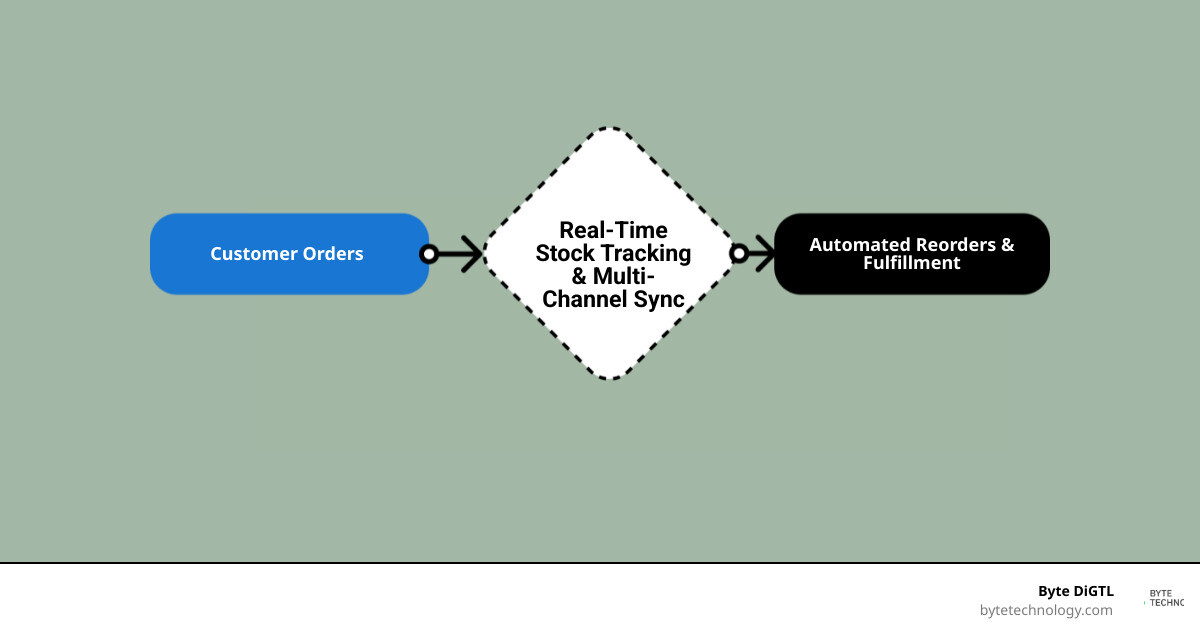
When you have high SKU counts, especially over 500 variants, and a web of over 100 suppliers, manual data entry becomes a liability. A dedicated inventory app for ecommerce acts as a central nervous system for your business. It connects your sales channels, warehouses, and suppliers in real time. This is essential for preventing the “big three” e-commerce headaches: overselling, stockouts, and manual errors.
We often see brands struggle with 6 things to consider for e-commerce success, and inventory management is consistently at the top of that list. Without real-time tracking, you cannot accurately forecast demand or manage lead times. This leads to cash being tied up in dead stock or, conversely, losing customers because your best-seller is out of stock.
Furthermore, the e-commerce community is currently facing a major shift. Stocky – Inventory Management for Shopify POS Pro | Shopify App Store is officially scheduled for sunset in August 2026. This means if you have been relying on Shopify’s native tool for your POS or warehouse needs, the clock is ticking to find a more robust, third-party solution. For a deeper dive into the basics of setting up your shop correctly, check out A beginners guide to e-commerce.

Top 7 Inventory Apps to Scale Your Business
Choosing the right tool is about more than just the monthly fee. You need to consider how well an app handles multi-channel sync, whether it offers demand forecasting, and if it can automate your replenishment. Below is a breakdown of the top seven apps that are helping merchants save their sanity in 2026.
| Feature | Best For | Key Advantage |
|---|---|---|
| Multi-channel Sync | Trunk | Real-time speed across 15+ channels |
| Demand Forecasting | Prediko | AI-driven restock suggestions |
| Manufacturing | Katana | Raw material and production tracking |
| High Volume | Finale | 200% accuracy for massive SKU counts |
| Retail Sync | Thrive | Seamless POS and e-commerce integration |
1. Finale Inventory: Best for High-Volume Scaling
For businesses that have outgrown everything else, Finale Inventory is often the final destination. It is built for brands that are scaling rapidly and need ERP-level control without the million-dollar price tag.
Finale users have reported achieving 40% faster warehouse operations and a 200% increase in inventory accuracy. This is largely due to its robust barcode scanning capabilities, which eliminate the “human element” of picking and packing errors. Whether you are managing one warehouse or five, Finale provides a single source of truth.
Using an app like this is one of the 8 simple ways to maximize your online store revenue, as it prevents lost sales from stockouts. It also handles landed costs and COGS (Cost of Goods Sold) with extreme precision, which is vital for maintaining healthy margins as you scale.
2. Cin7: The Enterprise-Grade inventory app for ecommerce
Cin7 (including Cin7 Core, formerly DEAR Systems) is a powerhouse for multi-channel integration. With pricing starting at $349 a month, it is a mid-to-high-range investment, but it offers features that budget apps simply cannot touch.
It excels at complex workflows, such as built-in EDI (Electronic Data Interchange) for selling to big-box retailers and deep integrations with Shopify e-commerce development environments. If your business involves wholesale, retail, and e-commerce all at once, Cin7 acts as the bridge that keeps every channel in sync. It is particularly strong for businesses that need to track serial numbers, batches, or expiry dates across a global supply chain.
3. Prediko: Best for AI-Driven Forecasting
In 2026, guessing when to reorder is no longer an option. Prediko is a modern inventory app for ecommerce that focuses heavily on the “planning” side of the house. Starting at $119 per month for businesses with under $500,000 in annual revenue, it is accessible for growing brands.
Prediko uses AI to analyze your historical sales data and predict exactly when you will run out of stock. It factors in supplier lead times and even helps with PO (Purchase Order) automation. We find it especially useful for brands exploring the power of product bundling for e-commerce sales, as it can track component-level inventory to ensure you never sell a bundle you cannot fulfill.
4. Katana: Best for Direct-to-Consumer Manufacturers
If you make what you sell, you don’t just need to track finished goods; you need to track raw materials. Katana is designed specifically for DTC manufacturers. Its visual interface makes it easy to see the status of production jobs in real time.
With a Starter tier at $199 per month, Katana bridges the gap between e-commerce development and the factory floor. It allows you to see if you have enough fabric, wood, or ingredients to finish a batch of orders. This “total visibility” prevents production delays and ensures that your Shopify store only reflects what you can actually build and ship.
5. Trunk: Best for Real-Time Multi-Channel Syncing
Trunk is the “set it and forget it” choice for merchants who sell on every platform imaginable. Whether it is Shopify, Amazon, eBay, Etsy, or TikTok Shop, Trunk ‑ Stock Sync & Bundling – Keep inventory synced in real-time across everywhere you sell | Shopify App Store keeps everything aligned.
Trunk is known for its incredibly lightweight and fast interface. It excels at bundle management and “duplicate SKU” syncing. For example, if you list the same product under three different names on Etsy to capture different search terms, Trunk ensures that when one sells, all three listings update their stock levels instantly. It is a massive time-saver for small to mid-sized teams.
6. Thrive by Shopventory: Best for Multi-Location Retail
For businesses that have both a physical storefront and an online presence, Thrive by Shopventory | Inventory Management Software is a top-tier choice. It is built to sync seamlessly with POS systems like Clover and Square, as well as Shopify and WooCommerce.
Thrive helps you stay ahead of top e-commerce website design trends for 2023 and beyond by ensuring your “Buy Online, Pick Up In Store” (BOPIS) features actually work. Nothing ruins a customer’s experience faster than driving to a store for an item that was actually sold online ten minutes prior. Thrive’s intelligent stock forecasting and expiration tracking make it a favorite for specialty retail and food-based e-commerce.
7. Sortly: The Best Entry-Level inventory app for ecommerce
If you are just starting out and find the other options too complex, Sortly: Inventory Simplified is a breath of fresh air. It uses a highly visual approach to inventory, allowing you to track items using photos and folders.
Sortly is great for how to optimize your e-commerce site for success because it focuses on the physical reality of your warehouse. With features like QR code scanning and offline mobile access, your team can perform stock counts even in parts of the warehouse with poor Wi-Fi. It is an excellent entry-level inventory app for ecommerce for those moving away from spreadsheets for the first time.
Choosing the Right Software for Your Store
Selecting an app is a major decision that impacts your daily operations. You should start by evaluating your “pain points.” Is your biggest issue overselling across channels? Or is it knowing when to reorder from 100 different suppliers?
For stores with over 500 SKUs, scalability is the most important factor. You don’t want to choose an app today only to outgrow it in six months. Look for apps that offer free trials and have a clear upgrade path. As you consider e-commerce website development-what-you-need-to-know, your inventory system must integrate perfectly with your website’s back end and your 3PL (Third-Party Logistics) provider if you use one.

Frequently Asked Questions
What happens when Stocky is sunset in August 2026?
Shopify has announced that Stocky will be discontinued on August 31, 2026. Merchants currently using it for POS Pro or basic forecasting should begin looking at third-party alternatives now. Apps like Stockful are already positioning themselves as replacements, offering historical data snapshots and more robust reporting that goes beyond Shopify’s standard 180-day history. We recommend starting a migration at least six months before the sunset date to ensure your historical data is preserved.
How do inventory apps prevent overselling?
Most high-quality apps use “real-time sync” and “buffer stock” settings. Real-time sync ensures that as soon as an order is placed on Amazon, your Shopify stock level drops. Buffer stock allows you to set a “safety net”—for example, telling the app to show “Out of Stock” on Etsy when you actually have two items left, just in case a walk-in customer buys them at your retail location. This zero-touch automation removes the need for manual updates.
Can I integrate my inventory app with QuickBooks or Xero?
Yes, and you absolutely should. Most of the apps listed above, including Cin7, Qoblex, and Thrive, offer direct accounting sync. This allows for automated landed cost calculations and real-time COGS tracking. When your inventory app talks to your accounting software, your financial reports (like P&L statements) become much more accurate, saving your accountant hours of manual reconciliation every month.
Conclusion
The transition from a manual spreadsheet to a dedicated inventory app for ecommerce is a milestone for any growing brand. It marks the shift from “surviving” to “scaling.” Whether you need the AI-driven brilliance of Prediko or the warehouse muscle of Finale Inventory, the right tool will protect your margins and keep your customers happy.
At BYTE DiGTL, we specialize in helping brands navigate these technical waters. Our Byte Bundles provide specialist teams to help with multi-channel strategies and technical implementations at a fraction of the cost of a full-time hire. If you are ready to stop the spreadsheet madness and start growing with confidence, we are here to help.