

How to Choose E-commerce Website Development Services That Drive Sales
The right e-commerce website development services should deliver more than a good-looking store. Look for a team that can build a fast, mobile-friendly site, create a simple checkout, connect secure payment gateways, support SEO, and scale with your inventory, traffic, and marketing tools.
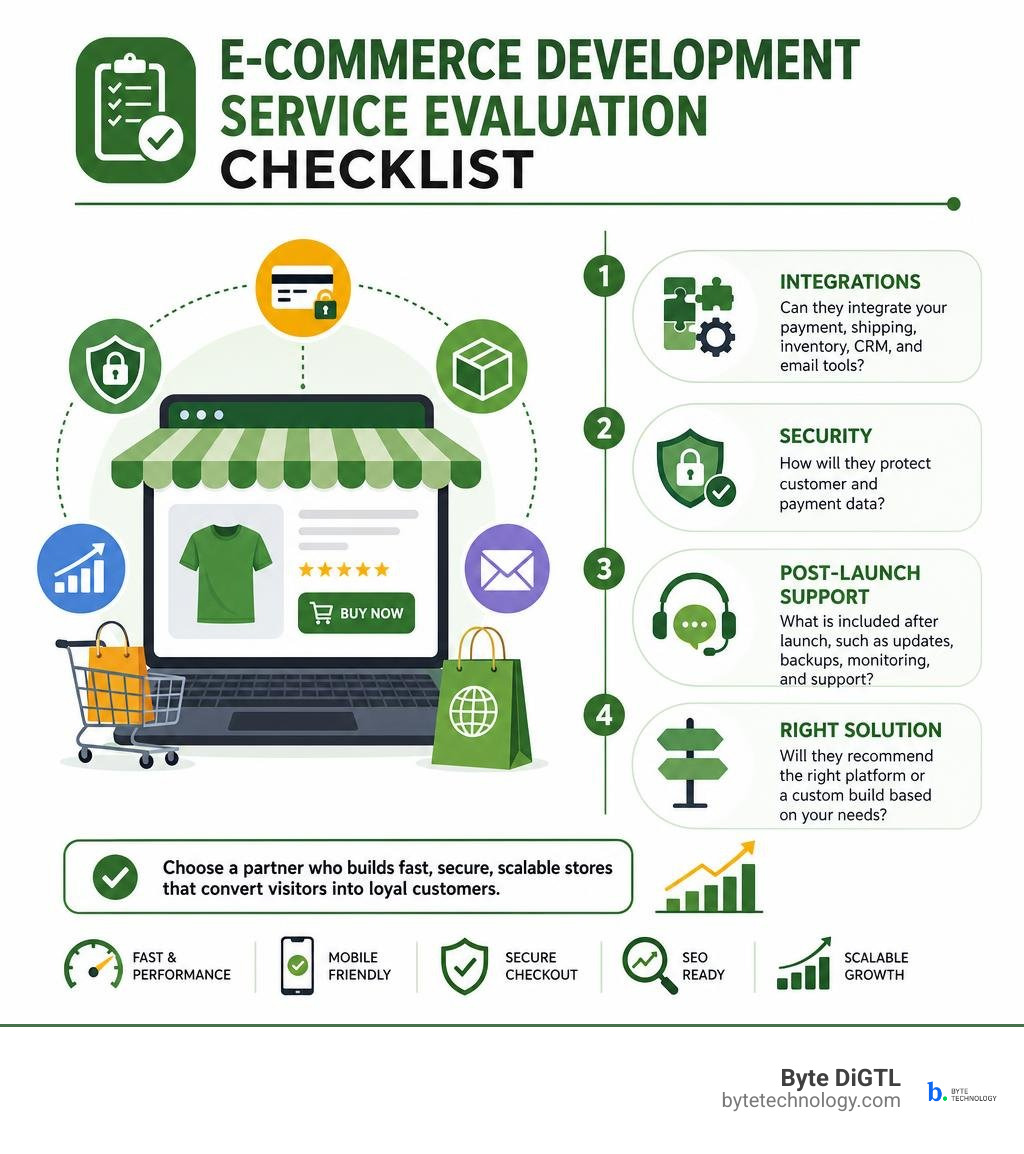
Before you hire, ask these questions:
- Can they integrate your payment, shipping, inventory, CRM, and email tools?
- How will they protect customer and payment data?
- What is included after launch, such as updates, backups, monitoring, and support?
- Will they recommend Shopify, Magento, or a custom build based on your actual needs?
The stakes are real. The global e-commerce market is projected to reach $8.1 trillion in 2026, while 94% of consumers say website design shapes whether they trust a brand. Slow or confusing stores also lose revenue. A one-second page-load delay can reduce conversions by 7%, and the average cart abandonment rate is 69.82%.
Simple e-commerce website development services glossary:
- BigCommerce Web Design Services
- E-commerce Website Development
- E-commerce Website Development in India
What to Expect from Professional E-commerce Website Development Services
A reliable development partner goes far beyond uploading a pre-made template and adding product photos. Modern digital commerce requires a resilient technical foundation, frictionless user journeys, and clean database structures that perform reliably under heavy transaction volumes.
When evaluating potential agencies, expect full-stack competence. This means your agency crafts custom user interface designs focused on usability, engineers database schemas that prevent bottlenecks during flash sales, and connects APIs smoothly across your operational tech stack.
Core Capabilities of Modern E-commerce Website Development Services
Your digital store must act as the central hub of your business operations. Professional development teams ensure that every customer action triggers the appropriate backend workflow automatically.
Essential core capabilities include:
- Custom workflow automation to streamline order routing and returns.
- Enterprise Resource Planning (ERP) integrations to sync procurement, accounting, and supply chain data in real time.
- Customer Relationship Management (CRM) synchronization to give sales and support teams complete customer purchase histories.
- Advanced inventory management systems that update stock levels across multiple warehouses and digital storefronts instantly.
If you are exploring the foundational steps of building your online store, our A-Z Guide to E-commerce Website Development breaks down each operational phase in detail.
Payment Gateways, Security, and Shopping Cart Integration
A secure, intuitive checkout experience is the difference between a completed purchase and an abandoned cart. With 88% of online shoppers less likely to return to a website after a poor user experience, your checkout flow must be flawless.

Professional developers build resilient payment pipelines by prioritizing:
- PCI-DSS Compliance: Maintaining strict adherence to Payment Card Industry Data Security Standards to ensure customer payment credentials never touch vulnerable servers.
- SSL Encryption and Tokenization: Encrypting sensitive data in transit and using tokenization protocols so third-party payment gateways handle card details directly.
- Frictionless, Multi-Gateway Options: Providing native support for major credit cards, digital wallets like Apple Pay and Google Pay, and buy-now-pay-later services.
- One-Click Checkout Optimization: Reducing form fields and streamlining guest checkout flows to drive higher completion rates.
To understand all technical requirements before launching your store, review E-commerce Website Development: What You Need to Know.
Choosing the Right Tech Stack: Custom Builds vs. Established Platforms
Selecting your technical architecture is one of the most critical decisions in your project. The ideal setup depends on your transaction volumes, business logic complexity, internal technical capabilities, and total cost of ownership goals.
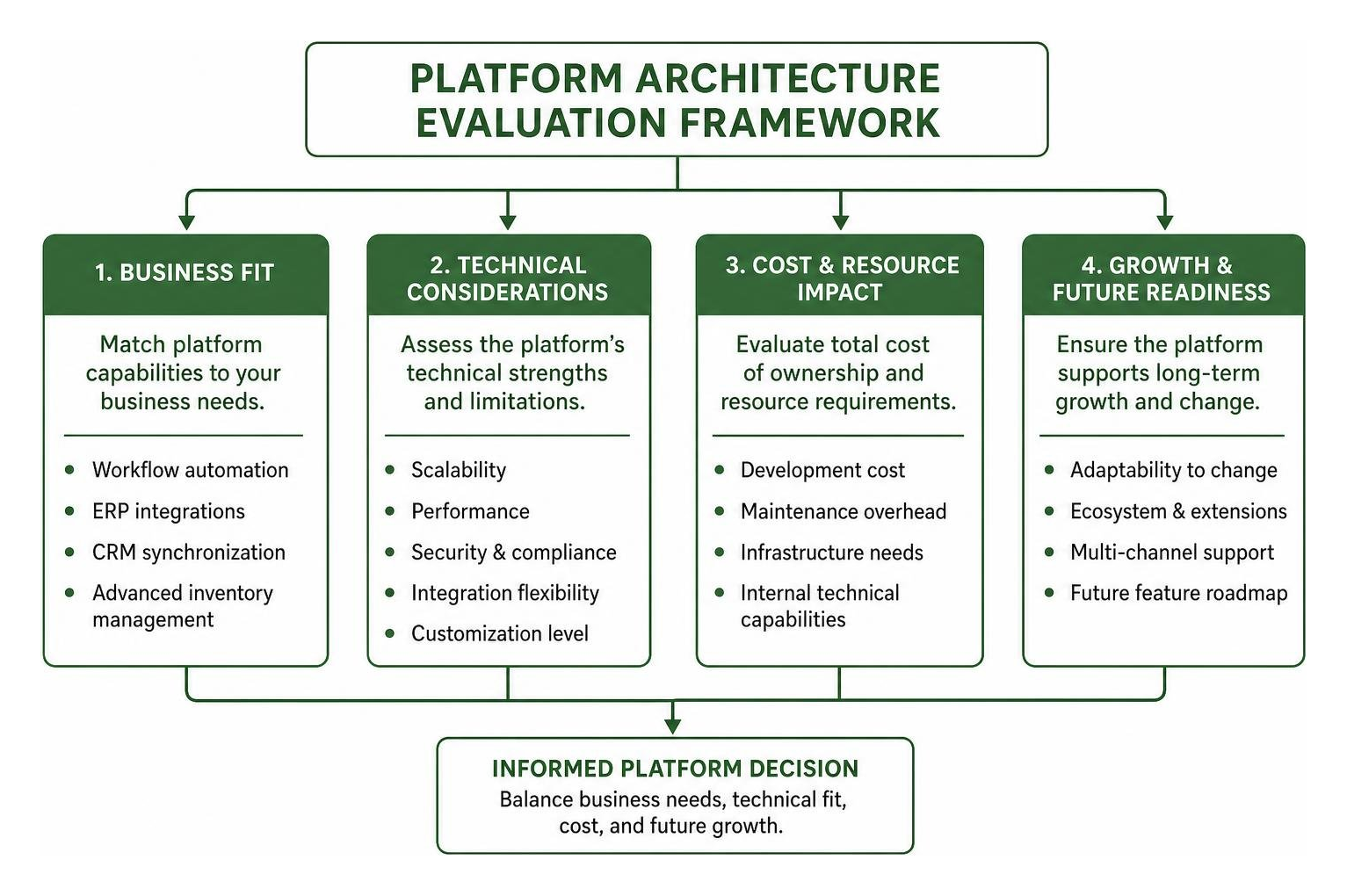
A fully custom build gives you complete control over your code, database, and features without being constrained by platform limits. However, established platforms often deliver faster time-to-market and lower initial investment.
Evaluating Platforms for E-commerce Website Development Services
Every platform comes with distinct tradeoffs regarding scalability, maintenance overhead, and customizability:
| Criteria | Custom Development | Shopify / Shopify Plus | Magento (Adobe Commerce) |
|---|---|---|---|
| Best For | Complex, bespoke business models | Fast launch, standard D2C and B2B | Large product catalogs, advanced B2B |
| Hosting Model | Dedicated cloud (AWS, GCP) | Fully managed SaaS | Self-hosted or Adobe Cloud |
| Customizability | 100% unlimited flexibility | Moderate (Theme/App limits) | Extensive open-source flexibility |
| Maintenance | Full codebase ownership | Managed by platform | Regular patches and updates required |
| Time to Launch | 4 to 9+ months | 1 to 3 months | 3 to 6 months |
For teams wanting rapid deployment and reliable hosted infrastructure, exploring Shopify E-commerce Development is an excellent starting point. If you are new to the ecosystem, our Beginner’s Guide to Shopify Development Services walks through the core features.
Conversely, enterprises managing intricate multi-store setups and custom pricing models often require a dedicated Magento Development Company to implement high-performance open-source systems.
Enterprise Scalability and Headless Commerce Architecture
As transaction volumes expand, monolithic architectures can slow down frontend rendering and limit design flexibility. Headless commerce decouples the frontend presentation layer from the backend commerce logic, connecting them through secure APIs.
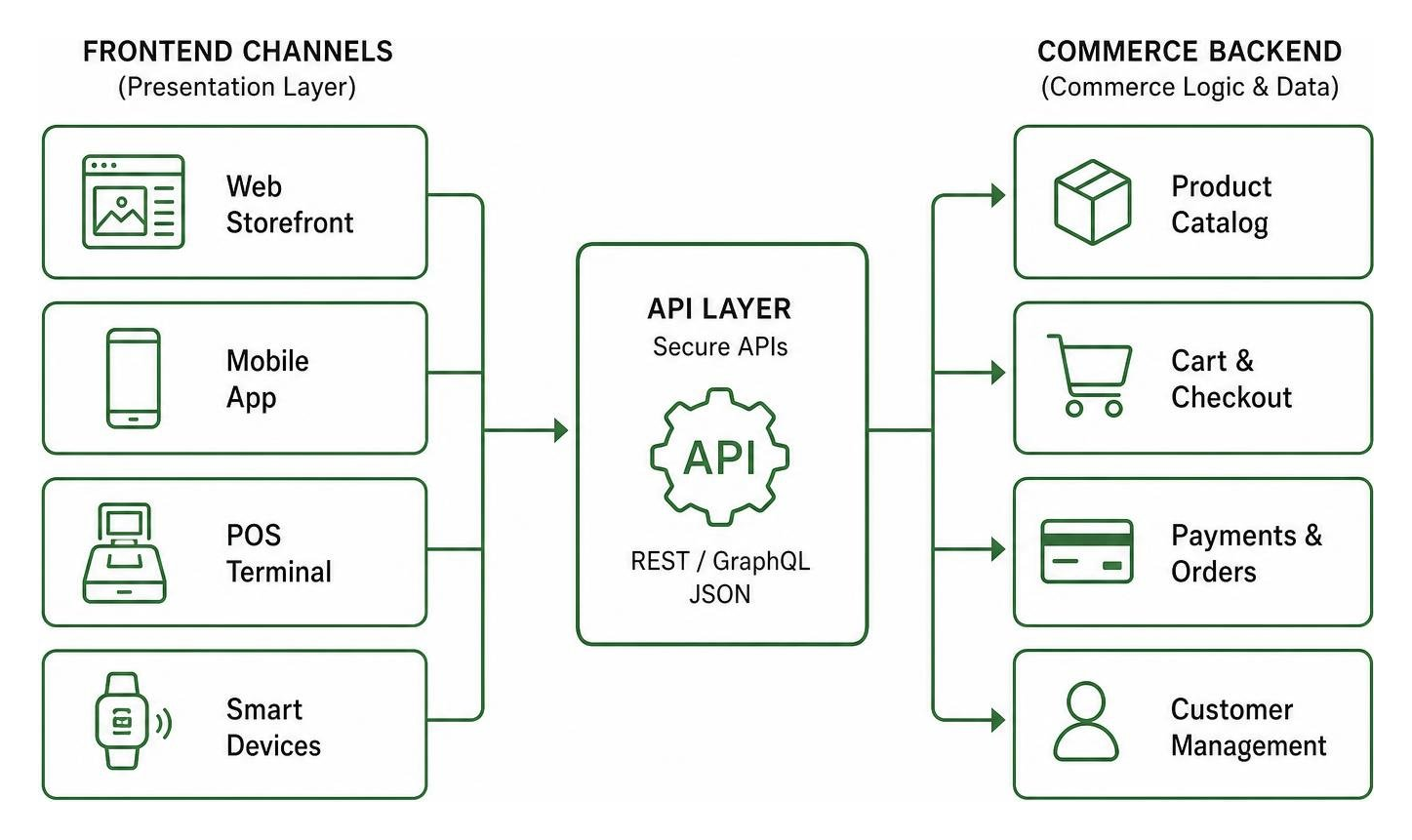
Leading brands adopt headless architecture because it offers:
- High-Concurrency Traffic Handling: Decoupled frontends built on modern frameworks like Next.js serve static assets globally via Content Delivery Networks (CDNs), allowing your site to withstand massive traffic spikes during promotional campaigns.
- Omnichannel Content Distribution: A single backend product catalog can power web storefronts, native mobile apps, POS terminals, and smart devices via APIs.
- Customized User Experiences: Marketing teams can rapidly test and deploy modern UI interfaces without risking backend database stability.
To see why growing enterprises select modular, scalable foundations, read Why Your Business Needs a Magento Development Company Right Now.
Technical SEO, Mobile Commerce, and Conversion Optimization
Mobile devices drive the majority of online shopping. Mobile commerce accounts for over 70% of total e-commerce transactions, making a mobile-first responsive design essential for customer retention.
Performance is directly tied to revenue. Research shows that 53% of mobile visits are abandoned if a page takes longer than 3 seconds to load, and a 1-second delay reduces conversions by 7%.
To maximize organic search visibility and user engagement, professional developers implement:
- Core Web Vitals Optimization: Refining Largest Contentful Paint (LCP), Interaction to Next Paint (INP), and Cumulative Layout Shift (CLS) scores through image compression, code splitting, and browser caching.
- Structured Schema Markup: Implementing Product, Offer, AggregateRating, and BreadcrumbList JSON-LD schemas so search engines display rich snippets in search results.
- Canonical Architecture and Faceted Navigation: Managing URL parameters properly to prevent duplicate content issues across complex product filters and category pages.
- Conversion-Driven UX: Designing sticky add-to-cart buttons, clear mobile payment buttons, and transparent shipping calculators.
Stay ahead of customer expectations by reviewing Top E-commerce Website Design Trends and learning practical growth tactics in How to Optimize Your E-commerce Site for Success.
Project Timelines, Cost Variables, and Post-Launch Support
Developing an enterprise digital storefront follows structured development milestones:
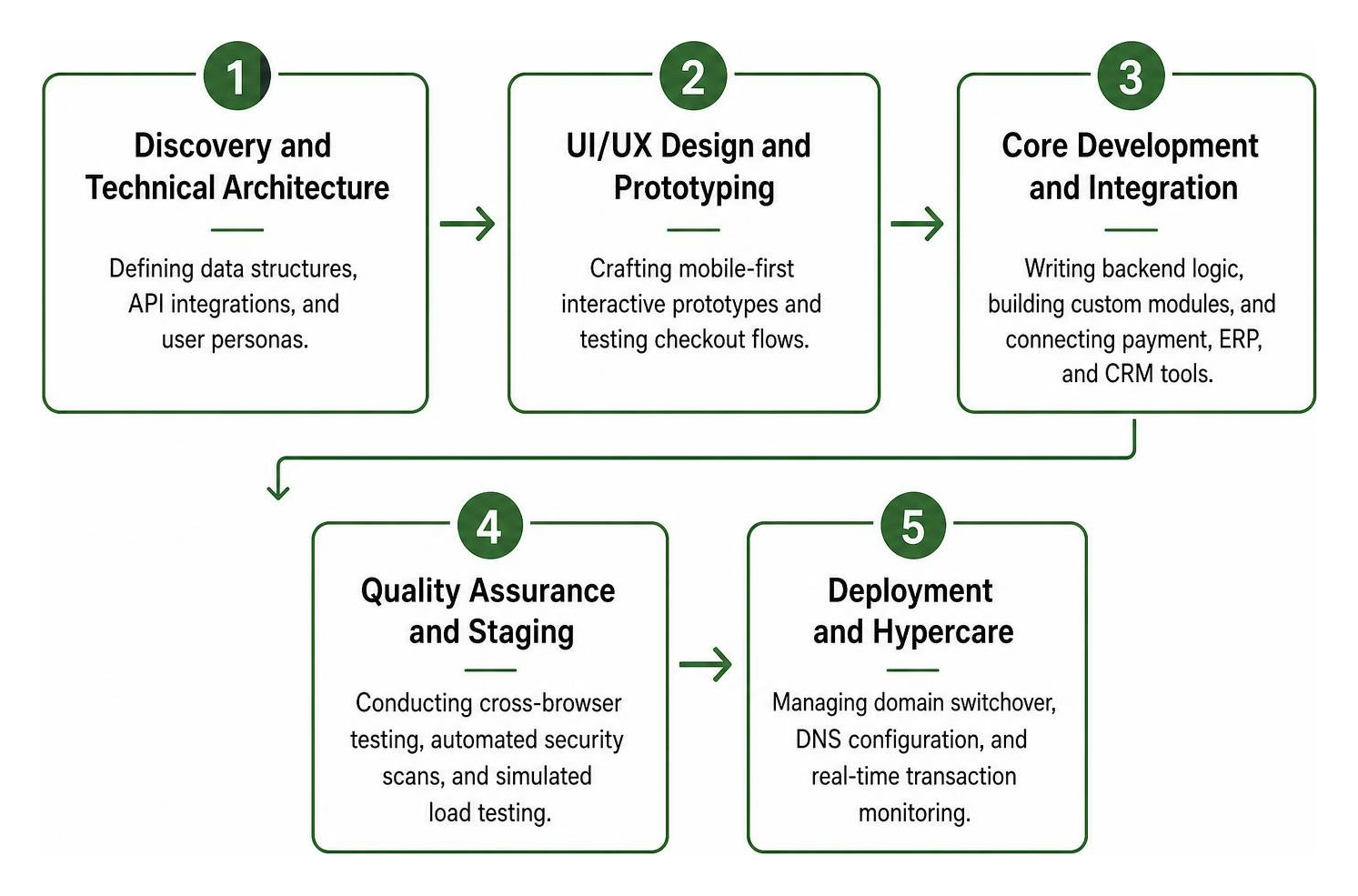
- Discovery and Technical Architecture: Defining data structures, API integrations, and user personas.
- UI/UX Design and Prototyping: Crafting mobile-first interactive prototypes and testing checkout flows.
- Core Development and Integration: Writing backend logic, building custom modules, and connecting payment, ERP, and CRM tools.
- Quality Assurance and Staging: Conducting cross-browser testing, automated security scans, and simulated load testing.
- Deployment and Hypercare: Managing domain switchover, DNS configuration, and real-time transaction monitoring.
Businesses that invest in custom e-commerce development see an average 30% increase in conversion rates, making the return on investment substantial when executed properly.
After launch, ongoing maintenance is vital to safeguard your store. Professional agencies provide continuous uptime monitoring, routine security patching, automated daily backups, and ongoing conversion rate optimization to keep your platform running at peak performance. Explore our complete suite of E-commerce Development Services to see how we build and support resilient digital stores.
Frequently Asked Questions About E-commerce Website Development
What is the typical timeline and cost to build a custom e-commerce store?
Timelines and budgets vary based on system complexity and the depth of custom integrations. A standard platform setup using Shopify or WooCommerce generally takes 4 to 8 weeks, with investments ranging from $5,000 to $20,000.
Complex enterprise builds or headless architectures involving ERP integrations and custom business logic typically require 3 to 6+ months, with development costs ranging from $25,000 to over $100,000.
How do development agencies ensure transactional security and data compliance?
Agencies implement multi-layered security protocols, including:
- Full Level 1 PCI-DSS compliance audits.
- SSL/TLS encryption across all site traffic.
- Tokenized payment gateway integrations (such as Stripe, PayPal, or Authorize.Net) so card data bypasses the store’s server.
- Web Application Firewalls (WAF), rate limiting, and automated bot detection to block fraudulent checkout attempts.
What post-launch maintenance and support do development services provide?
Post-launch services usually include 24/7 uptime and server monitoring, security patch management, automated database backups, framework and plugin updates, bug fixes, and ongoing SEO and speed audits. Many agencies also offer retainer-based conversion rate optimization (CRO) and feature development sprints.
Conclusion
Building a high-performing e-commerce store requires a strategic balance of design, modern engineering, robust security, and reliable post-launch maintenance. Whether you choose a fully custom headless build or a scalable platform implementation, your digital store must deliver rapid load times, seamless checkout experiences, and dependable operational integrations.
Ready to launch a fast, scalable store that turns visitors into repeat customers? Connect with our team to explore our Shopify E-commerce Development services and discover how we can accelerate your digital growth.