

Why Shopify Ecommerce Development Is One of the Smartest Investments You Can Make Right Now
Shopify ecommerce development is the process of building, customizing, and scaling an online store on the Shopify platform — from theme design and custom app integrations to full-scale enterprise solutions.
Here’s what it covers at a glance:
| What It Involves | What You Get |
|---|---|
| Custom theme design | A store that looks and feels like your brand |
| App & API integrations | Connected tools like ERP, CRM, and payment gateways |
| Performance optimization | Faster pages, better SEO, higher conversions |
| Ongoing maintenance | A store that grows with your business |
| Partner/expert support | Vetted specialists for every stage of development |
Online shopping is no longer a trend — it’s the direction everything is heading. Ecommerce made up just 18% of global retail sales in 2017. By 2027, that number is forecast to hit 41% (Boston Consulting Group). With nearly 1.92 billion people shopping online today, the opportunity is massive. But here’s the catch: 96% of visitors leave a website without buying anything. That means how your store is built matters enormously.
A basic template can get you started. But if you want to stand out, convert browsers into buyers, and scale without hitting walls, you need a store built with intention.
I’m Matthew Purdom, Director of Web Development at Byte DiGTL, and with over a decade of experience in front-end and back-end architecture, technical SEO, and performance optimization, I’ve helped brands navigate the full spectrum of Shopify ecommerce development — from first launch to enterprise-level scaling. Let’s break down exactly what that looks like in practice.

Understanding Custom Shopify Ecommerce Development
When we talk about custom shopify ecommerce development, we aren’t just talking about picking a color scheme and uploading a logo. We are talking about the strategic process of planning and implementing a unique online store tailored to specific business needs. Think of it like the difference between buying a suit off the rack and having one tailored to your exact measurements. One “fits,” but the other makes you look like a million bucks and allows you to move without restriction.
Custom development empowers your brand to stand apart from the sea of generic-looking websites. According to Boston Consulting Group ecommerce growth research, the number of sites is skyrocketing, meaning the “standard” look just won’t cut it anymore. Customization becomes essential when premade solutions lack the specific features or integrations your business model requires.
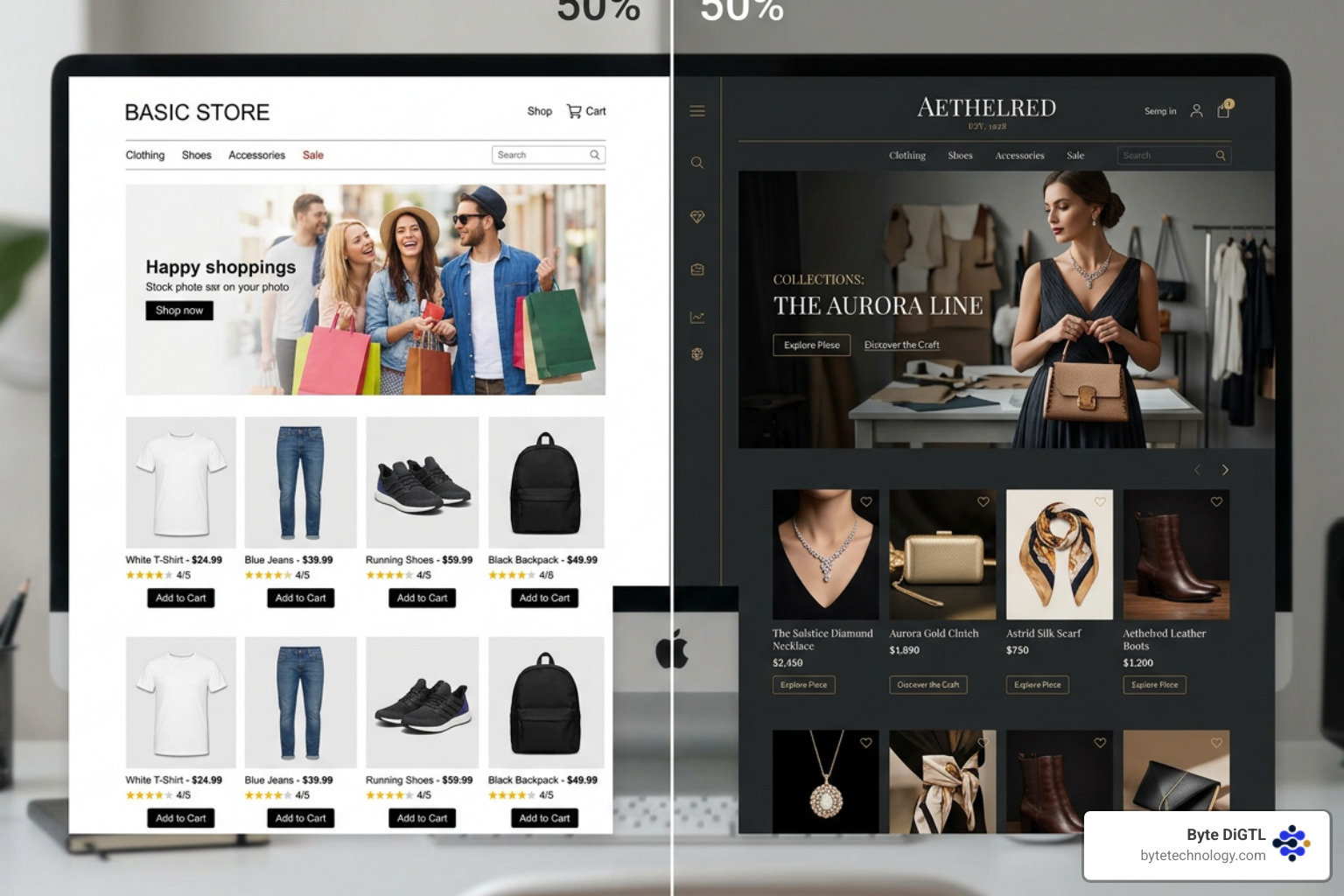
| Feature | Custom Development | Off-the-Shelf Platforms |
|---|---|---|
| Design Flexibility | Limitless; reflects unique brand identity | Restricted to template layouts |
| Scalability | High; built to handle growth and high volume | Can hit performance ceilings quickly |
| Integrations | Seamless connection to ERP, CRM, and PIM | Often reliant on limited, third-party apps |
| User Experience | Optimized for your specific customer journey | Generic flow for the “average” user |
| Ownership | Greater control over code and functionality | Bound by the platform’s standard features |
For many businesses, the journey starts with a simple setup, but as they grow, they realize they need more. This is where more info about ecommerce development services becomes invaluable. Custom development isn’t just about aesthetics; it’s about building a robust backend that can sync with your warehouse, manage complex tax rules, or offer a unique subscription model that a standard theme simply can’t handle.
Analyzing Requirements for Shopify Ecommerce Development
Before a single line of code is written, we have to do our homework. We believe that coding is actually one of the last stages of a successful project. First, we must analyze the business processes and requirements. This involves:
- Stakeholder Interviews: We talk to the people running the business to understand their pain points. Are they spending 20 hours a week manually updating inventory? That’s a problem development can solve.
- Technical Audits: We look at what you already have. If you’re migrating from another platform, we need to map out every data point to ensure nothing is lost.
- Project Roadmapping: We create a blueprint. You wouldn’t build a house without a plan, and you shouldn’t build a store without a roadmap that defines success post-launch.
- Customer Base Analysis: Who is shopping? If your audience is primarily on mobile (which most are these days), the development priorities shift toward thumb-friendly navigation and lightning-fast load times.
- Growth Planning: We don’t just build for where you are today; we build for where you want to be in three years. This prevents “technical debt”—the expensive process of having to tear everything down and start over because the initial build was too shortsighted.
The Strategic Process of Shopify Ecommerce Development
Once the strategy is set, the actual building begins. Modern shopify ecommerce development leverages powerful tools like Shopify CLI 3.0, which allows developers to initialize themes, apps, and storefronts instantly. This speeds up the process, but the human element of design remains the most critical factor.
The best designs are often “invisible”—they feel so natural that the user doesn’t have to think about where to click next. We focus heavily on UI/UX design, creating wireframes that map out the user journey. We also prioritize accessibility. Using tools like WebAIM accessibility features and the WAVE accessibility evaluation tool, we ensure that your store is usable by everyone, including those with disabilities. This isn’t just a moral choice; it’s a business one. Following WCAG guidelines helps you reach a wider audience and improves your SEO.
Testing and Quality Assurance (QA) are where we break things on purpose so your customers don’t. We test for technical issues, usability across different browsers, and performance on various devices. Only after a rigorous QA process do we move to deployment. But even then, the work isn’t done. A website is a living asset. For more details, check out our guide on how to optimize your ecommerce site for success.
Maximizing ROI through Shopify Ecommerce Development
The goal of any development project is to make more money than you spent on the build. We focus on four key pillars to maximize your Return on Investment (ROI):
- Conversion Rate Optimization (CRO): The top 20% of Shopify stores have conversion rates over 3.2%, while the bottom 20% hover around 0.4%. Strategic development—like simplifying the checkout flow or adding “Shop Pay”—can bridge that gap.
- Page Speed: A one-second delay in page load time can lead to a significant drop in conversions. We optimize image assets and clean up “app bloat” to keep things snappy.
- Mobile Responsiveness: Since a huge chunk of the 1.92 billion global shoppers are on their phones, your site must look perfect on a 6-inch screen.
- SEO Preservation: If you are redesigning or migrating, the last thing you want is to lose your Google rankings. We implement 301 redirects and maintain URL structures to keep your traffic flowing.
If you’re wondering whether you can do this yourself, it’s worth considering why you need a Shopify web designer. While Shopify is user-friendly, a professional ensures the technical foundation is solid enough to support high-growth marketing campaigns.
Advanced Functionalities, Integrations, and Scalability
As your business matures, you’ll likely need to connect Shopify to the rest of your “tech stack.” This is where advanced shopify ecommerce development shines. We often build custom app integrations to connect stores with ERP (Enterprise Resource Planning) systems like NetSuite or SAP, and CRMs like Salesforce or HubSpot.
One of the most effective ways to increase revenue is through the power of product bundling for sales. While there are apps in the Shopify App Store for this, a custom-developed bundling solution can offer a much smoother user experience and better inventory tracking.
For businesses looking to go truly “next-level,” we explore:
- Headless Commerce: Separating the front-end (what the user sees) from the back-end (the Shopify engine). This allows for total creative freedom using frameworks like Hydrogen.
- International Selling: Setting up Shopify Markets to handle multiple currencies, languages, and regional tax rules.
- B2B Storefronts: Creating dedicated portals for wholesale clients with custom price lists and bulk order forms.
- Subscriptions: Integrating recurring billing models that keep customers coming back month after month.
Navigating Partner Tiers and Development Costs
Finding the right help is crucial. The Shopify Experts directory is a great place to start, but you should understand how the Partner ecosystem works. Shopify Partners are often tiered based on their experience and proven success:
- Select/Plus Partners: These are vetted agencies with a track record of handling high-volume merchants and complex builds.
- Premier/Platinum: These represent the top tier of the ecosystem, often working with global brands.
When it comes to costs, shopify ecommerce development varies wildly. A standard theme customization might take 4–8 weeks and cost a few thousand dollars. A fully custom Shopify Plus build with deep ERP integrations can take 3–6 months and range from $20,000 to over $100,000.
Don’t let the upfront cost scare you. You have to look at the ongoing maintenance and the ROI. A store that saves you 20 hours of manual work a week or increases your average order value by 15% pays for itself very quickly. We always recommend building a budget that includes post-launch support for A/B testing and performance tuning.
Frequently Asked Questions about Shopify Ecommerce Development
Can Shopify stores be fully customized, and what are the limitations?
Yes, Shopify stores can be incredibly customized, but there are some boundaries. The primary tool for customization is Liquid, Shopify’s templating language, along with HTML, CSS, and JavaScript.
The main “limitation” used to be the checkout page, which was strictly locked down for security. However, with Checkout Extensibility, Shopify Plus merchants can now customize the checkout experience significantly. The platform’s restrictions are generally there to ensure 99.99% uptime and PCI DSS Level 1 compliance, which actually protects you and your customers.
How does custom development improve scalability for growing businesses?
Custom development improves scalability by reducing “technical debt” and optimizing performance. When a store is built specifically for your needs, it handles high-volume traffic much better than a site weighed down by twenty different third-party apps.
We can also build automated workflows—like syncing inventory across multiple locations or automating customer segmentation—which allows your team to focus on marketing rather than manual data entry.
What is the difference between a theme customization and a custom build?
- Theme Customization: We take a pre-built theme from the Shopify Theme Store and tweak it. It’s faster and more budget-friendly, but you are still working within the “bones” of that theme.
- Custom Build: We build the theme from scratch (often using a starter framework like Dawn or a headless approach). This is for brands that need a truly unique identity and specific functionalities that no off-the-shelf theme provides.
Conclusion
At the end of the day, your online store is your most important salesperson. It works 24/7, never takes a sick day, and can talk to thousands of people at once. Investing in professional shopify ecommerce development ensures that this salesperson is as effective as possible.
At Byte DiGTL, we specialize in creating high-performance e-commerce experiences. Our specialist teams provide multi-channel strategies through our affordable Byte Bundles, giving you access to expert developers, designers, and SEO specialists at a fraction of the cost of a full-time employee. We don’t just build websites; we build growth engines.
Ready to turn your vision into a high-converting reality? Start your shopify ecommerce development project today and let’s build something genius together.