

Understanding e-commerce website development and Its Business Impact
E-commerce website development is the process of planning, designing, building, and launching an online store — including everything from product pages and shopping carts to payment processing and order management.
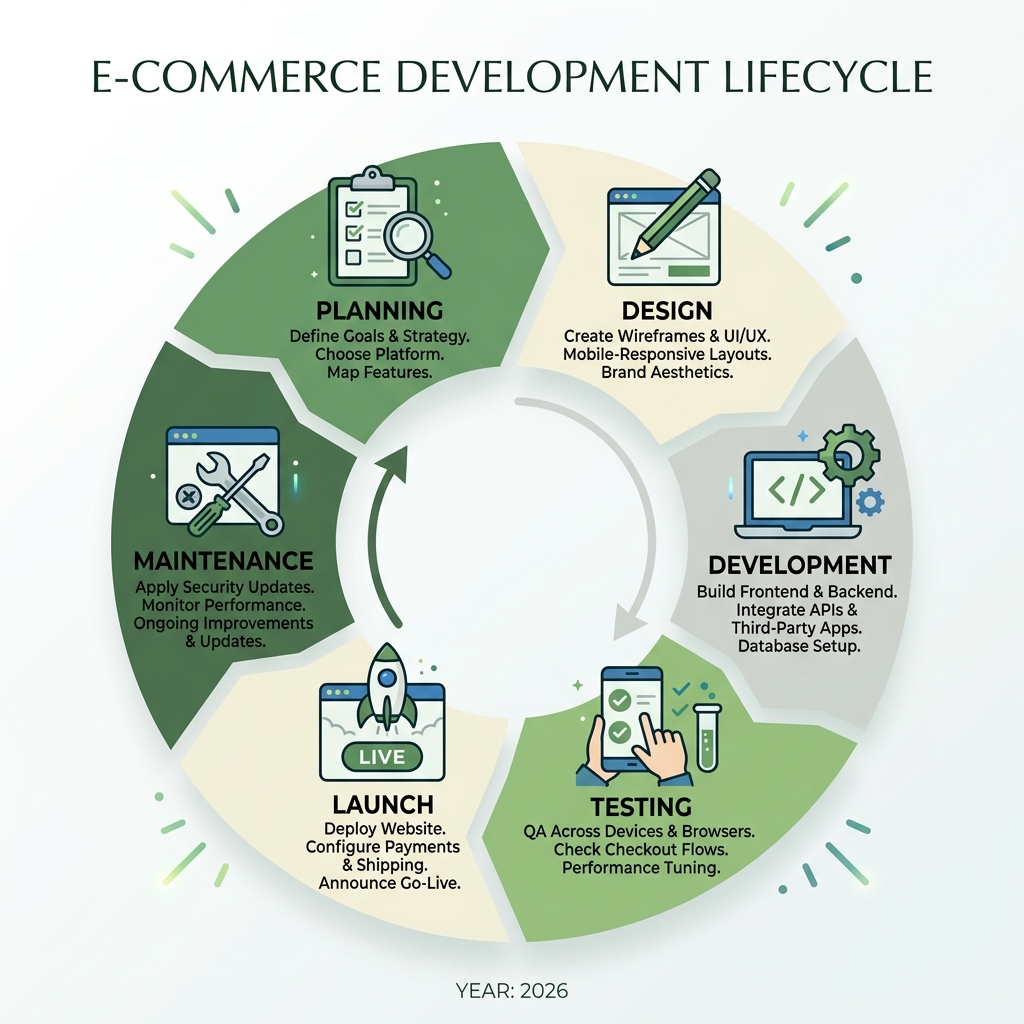
Here’s a quick overview of what it involves:
| Stage | What Happens |
|---|---|
| Planning | Define goals, choose a platform, map out features |
| Design | Create wireframes, UI/UX layouts, mobile-responsive templates |
| Development | Build frontend, backend, and integrate APIs |
| Testing | QA across devices, browsers, and checkout flows |
| Launch | Deploy, configure payments/shipping, go live |
| Maintenance | Security updates, performance tuning, ongoing improvements |
Whether you’re starting from scratch or upgrading an existing store, the right approach depends on your budget, technical needs, and growth goals.
Right now, there are an estimated 27.2 million e-commerce sites competing for the same customers. That number is only growing. And yet, 75% of consumers say they’ve abandoned a purchase simply because a website looked outdated or unprofessional.
That’s not a small problem. That’s lost revenue — happening silently, every day.
The global web development market hit $65.35 billion in 2023 and is projected to reach $130.9 billion by 2032. E-commerce isn’t slowing down. But standing out in that crowd requires more than just putting products online. It requires a site that’s fast, trustworthy, mobile-friendly, and built to convert.
For small business owners especially, navigating platforms, developers, costs, and technical decisions can feel overwhelming. This guide breaks it all down — clearly, without the jargon.
In today’s digital-first economy, your website is often the only “storefront” a customer ever sees. The impact of professional e-commerce website development extends far beyond just having a place to process credit cards. It is the foundation of your brand’s credibility.
Research shows that 75% of consumers have decided against a purchase because a website appeared outdated. Conversely, 92% of shoppers report higher confidence in a business when the site operates smoothly. “Smooth” means more than just a working “Buy” button; it means a cohesive digital transformation that aligns your inventory, marketing, and customer service into one high-performing machine.
When we look at 6 things to consider for e-commerce success, we emphasize that a professional design isn’t a luxury—it’s a revenue driver. A well-developed site reduces friction, builds trust through secure protocols, and ensures that your brand remains competitive in a global market projected to hit $130.9 billion by 2032.
Choosing the Right E-commerce Platform and Architecture
Selecting a platform is perhaps the most critical technical decision you will make. It dictates your long-term scalability, your daily ease of use, and your total cost of ownership.
| Feature | SaaS (Shopify/BigCommerce) | Open-Source (WooCommerce/Magento) | MACH Architecture (Headless) |
|---|---|---|---|
| Control | Limited to platform rules | Full control over code/data | Total “best-of-breed” flexibility |
| Maintenance | Handled by provider | User-managed updates/security | High technical complexity |
| Speed to Market | Very Fast | Moderate | Slow (Requires custom build) |
| Scalability | High (within ecosystem) | Unlimited (requires resources) | Maximum (enterprise level) |
Popular Platform Options
- WooCommerce development: As a plugin for WordPress, WooCommerce powers a massive portion of the web. It is ideal for businesses that want full ownership of their data and code without recurring platform subscription fees.
- Shopify development: This is the dominant hosted platform globally. It’s known for its excellent out-of-the-box mobile performance and a vast app ecosystem. It’s a great choice for those who want to focus on selling rather than server management.
- Magento development: Now known as Adobe Commerce, Magento is the powerhouse for enterprise-level stores. It offers unparalleled customization but requires professional developers to manage its complexity.
Modern Architecture: MACH and Headless
For larger brands, MACH architecture (Microservices, API-first, Cloud-native, and Headless) is often worth considering. Headless e-commerce decouples the frontend (what the customer sees) from the backend (the engine). This allows you to use a high-performance frontend like Next.js while keeping your product data in a robust backend. This API-first design ensures that as your business grows, your site remains fast, flexible, and ready for any future integration.
Building a High-Converting Online Store
A site that looks pretty but doesn’t sell is just an expensive digital brochure. To truly thrive, your e-commerce website development must focus on Conversion Rate Optimization (CRO).
With mobile transactions projected to account for 50% of US e-commerce sales by 2027, a mobile-first design is no longer optional. This means large “thumb-friendly” buttons, fast-loading images, and a checkout flow that doesn’t require a physical keyboard to complete.
Personalization is another game-changer. Using AI to suggest products based on browsing history can increase average order value by 30% or more. However, even the smartest AI can’t save a site with bad content. We always tell our clients that writing product descriptions that sell is an art form—you need to answer the customer’s questions before they even ask them.
Essential Features for Successful e-commerce website development
To keep shoppers from bouncing, your store needs a core set of features that work flawlessly:
- Advanced Search: Users who use the search bar are often 2-3 times more likely to convert. Ensure yours handles typos and synonyms.
- Secure Checkout: Minimize fields and offer guest checkout. Every extra click is an opportunity for a customer to leave.
- AI Recommendations: Use data to show “Customers also bought” or “Complete the look” sections.
- Multi-Currency & Language: If you sell in New York but have customers in London, your site should reflect that automatically.
- Optimizing your e-commerce site: This involves continuous testing of your UI/UX to ensure there are zero roadblocks between the landing page and the “Thank You” page.
The Step-by-Step Process of Custom e-commerce website development
Building a custom store is a marathon, not a sprint. Following a structured e-commerce website development guide ensures nothing falls through the cracks:
- Discovery Phase: We define your business goals, target audience, and must-have integrations (ERP, CRM, etc.).
- Data Modeling: We map out how your products, categories, and customer data will relate to each other.
- Wireframing & UI/UX Design: We create the blueprint of the site, focusing on user flow before we ever touch a line of code.
- Frontend & Backend Development: Our developers build the visual elements and the “engine” that powers your logic and databases.
- API Integrations: We connect your site to payment gateways (like Stripe or PayPal), shipping carriers, and marketing tools.
- Quality Assurance (QA): We test everything—broken links, mobile responsiveness, and payment processing—on dozens of device types.
- Deployment & Maintenance: After launch, we provide ongoing updates to keep the site secure and fast.
Security, Performance, and SEO Optimization
Security is the “silent” feature of ecommerce website development. If a customer doesn’t feel safe, they won’t buy. This requires PCI-DSS compliance for handling credit card data and SSL/TLS encryption to protect user information.
Performance is equally vital. A one-second delay in page load time can reduce conversions by up to 7%. We focus heavily on Core Web Vitals, optimizing images, and using Content Delivery Networks (CDNs) to ensure your site is lightning-fast, whether your customer is in Monterey or Minneapolis.
Finally, you need to be found. 3 e-commerce SEO tips we always recommend are:
- Technical SEO: Ensure your site architecture is “crawlable” by Google.
- Mobile-First Indexing: Google primarily uses the mobile version of your content for indexing and ranking.
- Schema Markup: Use structured data so search engines can see your prices and stock levels directly in the search results.
Staying on top of e-commerce design trends like dark mode and micro-animations can also give you a slight edge in user engagement, which indirectly boosts your SEO.
Frequently Asked Questions about E-commerce Website Development
How much does e-commerce website development cost?
The cost of e-commerce website development is a bit like the cost of a house—it depends on the size and the finishes.
- Basic Stores: Using templates on platforms like Shopify or Wix might cost between $1,000 and $5,000.
- Mid-Market Custom Stores: A tailored WooCommerce or Shopify Plus site typically ranges from $10,000 to $50,000.
- Enterprise Solutions: Fully custom, headless, or complex Magento builds often start at $60,000 and can exceed $200,000 for international, multi-brand setups.
Factors that influence price include the number of SKUs, the complexity of third-party integrations (like an ERP), and custom design requirements. You can find more detail on e-commerce development costs here.
How long does it take to develop and launch an e-commerce site?
A simple store can be launched in 4 to 6 weeks. However, a custom project involving deep discovery, custom UI/UX design, and complex backend integrations typically takes 3 to 6 months. The timeline is often dictated by the “readiness” of your product data and the complexity of your business logic.
What are the most common mistakes to avoid in e-commerce development?
We see the same pitfalls time and again:
- Ignoring Mobile: If your site is hard to use on a phone, you are losing half your potential revenue.
- Slow Loading Speeds: Shoppers are impatient. If it takes more than 3 seconds to load, they are gone.
- Complex Checkout: Requiring an account to buy or having too many steps leads to high cart abandonment.
- Poor SEO: If you don’t build SEO into the foundation, you’ll spend a fortune on ads just to get traffic.
- Weak Security: One data breach can end a small business. Never cut corners on SSL or PCI compliance.
Conclusion
Building a successful online store requires a blend of creative design and technical precision.
Ready to transform your digital presence? Let’s build something great together.