India’s eCommerce Boom: What It Means for Your Online Store
Ecommerce website development in India is one of the fastest-growing opportunities for small businesses right now — and the numbers back it up.
Here’s a quick snapshot of what you need to know:
| Factor | Key Detail |
|---|---|
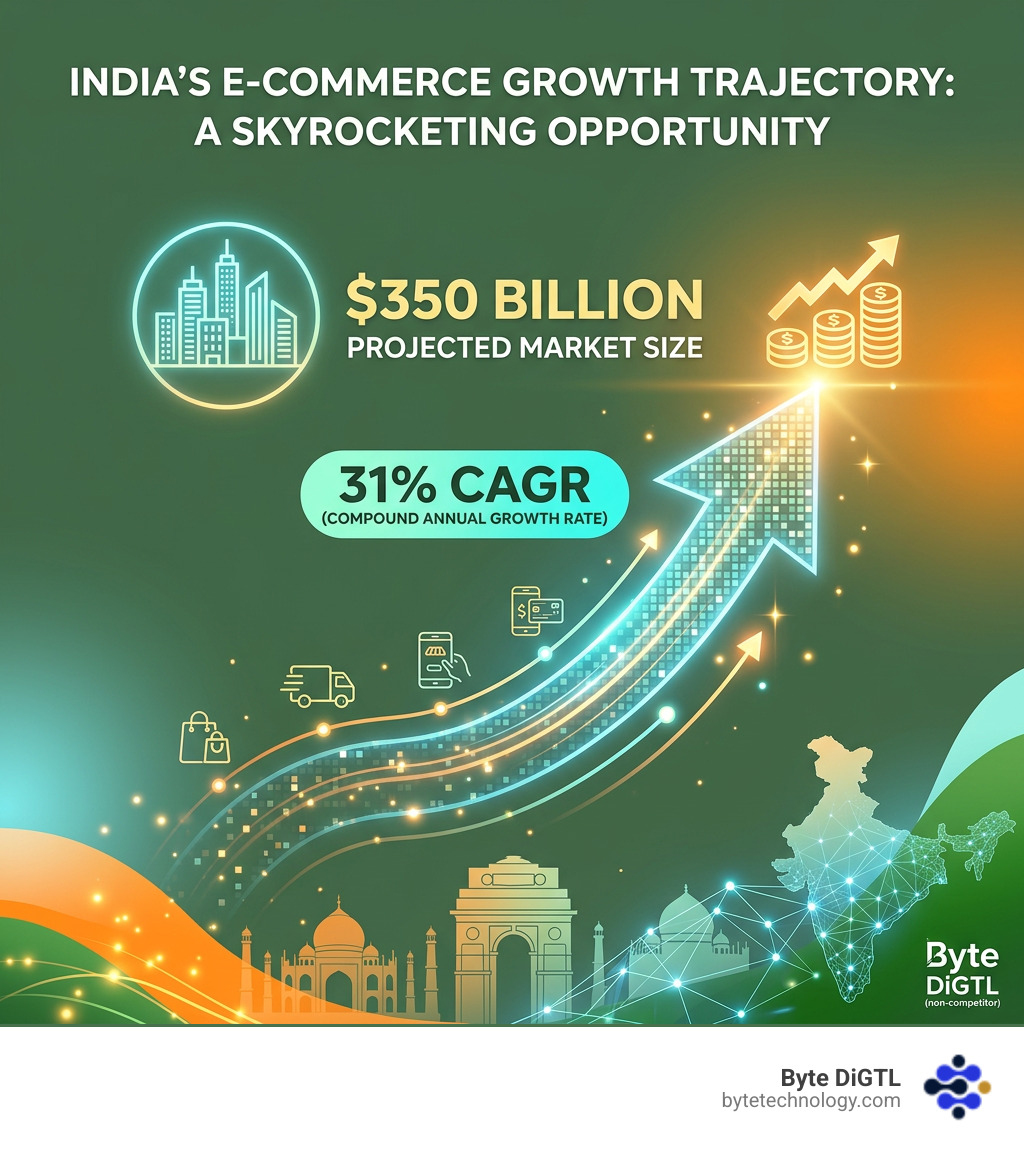
| Market size by 2026 | $350 billion |
| Annual growth rate (CAGR) | 31% |
| Mobile share of traffic | 70%+ |
| Basic store cost (INR) | Starting ~₹15,999 |
| Basic store timeline | 3–6 weeks |
| Enterprise store timeline | 4–6 months |
India’s online shopping market is growing faster than almost any other in the world. More than 350 million Indians shop online today, and that number keeps climbing.
For small business owners, this creates a real opportunity — and a real challenge.
Getting your store built the right way matters more than ever. A slow site, clunky checkout, or missing payment options can cost you sales before a customer even thinks about buying.
This guide cuts through the noise. It covers costs, timelines, platforms, and what to look for — so you can make a smart decision without wasting time or money.
I’m Matthew Purdom, Director of Web Development at Byte DiGTL, with over a decade of experience building scalable, high-performance ecommerce platforms — including projects in the ecommerce website development in India space. I’ll walk you through everything you need to know to build a store that actually sells.
Building Your Brand with ecommerce website development in india
When we talk about building a brand in the digital age, we aren’t just talking about a pretty logo. We are talking about creating a destination where customers feel safe, informed, and excited to shop. Choosing ecommerce website development in India offers a unique trifecta of benefits: cost-effectiveness, world-class technical expertise, and massive scalability.
India has become a top global destination for development because of its deep talent pool. Whether you are a startup looking for an affordable entry point or a large enterprise needing a complex architecture, the infrastructure here supports it all. One of the biggest advantages we see is the ability to offer 24/7 support across time zones, ensuring your store never sleeps even when you do.
However, a successful store requires more than just code. You need to consider 6 Things to Consider for Ecommerce Success to ensure you aren’t just launching a site, but launching a business. This includes a heavy focus on UI/UX (User Interface and User Experience). In a market where 1-second delays can lead to a 7% loss in conversions, speed and intuition are everything.
By focusing on multi-touchpoint engagement—meaning your store works seamlessly whether a customer finds you on Instagram, a Google search, or a direct link—you increase your “Customer Lifetime Value.” We often recommend 8 Simple Ways to Maximize Your Online Store Revenue such as implementing loyalty programs and personalized recommendations to keep shoppers coming back.
Popular Platforms for Modern Online Stores
Choosing the right “engine” for your store is the most critical technical decision you will make. In ecommerce website development in India, four names generally dominate the conversation.
- Shopify: This is the gold standard for many because of its ease of use. It’s a hosted platform, meaning you don’t have to worry about servers. It’s perfect for those who want to get up and running quickly. We specialize in Shopify Ecommerce Development to help brands customize this “out-of-the-box” solution into something truly unique.
- Magento (Adobe Commerce): If you have a massive catalog (thousands of products) and need deep customization, Magento is the powerhouse. It requires more technical “muscle” but offers unparalleled flexibility for B2B and large-scale B2C operations.
- WooCommerce: Built on WordPress, this is highly customizable and great for those who already love the WordPress ecosystem. It’s “open-source,” meaning you have total control over your data and hosting.
- BigCommerce: Similar to Shopify but often favored for its built-in advanced features that don’t require as many third-party apps.
- Headless Commerce: For the truly tech-forward, this separates the “head” (the part customers see) from the “body” (the backend operations). This allows for extreme speed and the ability to push your store content to smartwatches, kiosks, or any digital screen.
Selecting the Right Platform for ecommerce website development in india
How do you pick? We usually tell our clients to look at three things: business size, scalability needs, and budget.
If you are a small boutique, Shopify or WooCommerce is likely your best bet. If you are a wholesaler or a national retail chain, you might need to Choose the Best Magento Agency for Your Business to handle the complexity of ERP and inventory integrations.
Don’t just think about where you are today; think about where you want to be in three years. Switching platforms later is much more expensive than picking the right one now. Consider your integration capabilities—will you need to connect to a specific Indian accounting software or a local CRM? Ensure your platform choice supports those APIs.
Understanding the Development Process and Costs
Building a store is a journey, not a single event. A professional ecommerce website development in India process usually follows these steps:
- Discovery Phase: We sit down to understand your products, your audience, and your competitors.
- Wireframing: Creating a blueprint of the site without colors or images to focus on the “flow.”
- UI/UX Design: This is where the brand comes to life with visuals and interactive elements.
- Backend Development: The “engine room” where we set up the database, security, and integrations.
- Quality Assurance (QA): We break things on purpose to make sure your customers can’t. We test on every phone and browser imaginable.
Pricing Comparison Table
| Feature | Basic Store | Professional Store | Enterprise Solution |
|---|---|---|---|
| Avg. Cost | ₹15,999 – ₹40,000 | ₹75,000 – ₹2,00,000 | ₹5,00,000+ |
| Platform | WooCommerce / Shopify | Shopify / Magento | Custom / Headless / Magento |
| Product Limit | Up to 100 | Unlimited | Unlimited (Multi-vendor) |
| Payment Gateways | 1 (e.g., Razorpay) | Multiple + International | Custom API Integrations |
| Design | Template-based | Custom UI/UX | Bespoke Branding |
For more specific details on how these phases work, you can check out our guide on Ecommerce Development or Talk To Expert to get a personalized quote.
Estimating the Timeline for ecommerce website development in india
Time is money, especially in retail. Here is what you can realistically expect for a timeline:
- Basic Stores (3-6 weeks): These are usually template-based stores with standard features. Most of the time is spent on product uploads and payment testing.
- Medium Projects (2-3 months): This involves custom design work, more complex shipping rules, and perhaps a few third-party integrations (like a CRM or email marketing tool).
- Complex Enterprise Solutions (4-6 months): These involve custom-built features, multi-vendor marketplaces, or “headless” setups. Custom integrations with legacy ERP systems often extend this timeline.
Understanding Ecommerce Website Development: What You Need to Know regarding timelines helps you plan your inventory and marketing launches effectively.
Essential Features for High-Converting Stores
If your store is hard to use, people will leave. It’s that simple. Here are the “non-negotiables” for any modern store:
- Mobile Responsiveness: With over 70% of Indian traffic coming from mobile, your site must be “thumb-friendly.” If the “Buy Now” button is too small, you’re losing money.
- Payment Gateways: In India, you need more than just credit card support. You need UPI (Google Pay, PhonePe), Net Banking, and often Cash on Delivery (COD). Integrating providers like Razorpay or PayU is essential.
- SEO Optimization: If Google can’t find you, customers won’t either. Check out these 3 Ecommerce SEO Tips for 2026 to get a head start. This includes fast load times, clean URLs, and optimized product descriptions.
- Security: SSL certificates are a must, but so is PCI-DSS compliance to protect customer data. High-quality ecommerce website development in India includes regular security audits to prevent hacking.
- Inventory Management: Your site should automatically hide products that are out of stock. Nothing kills a customer’s mood faster than buying something and getting an “oops, out of stock” email two hours later.
- Integrations: Connecting your store to ERP (Enterprise Resource Planning), CRM (Customer Relationship Management), and shipping APIs like Shiprocket ensures your operations run smoothly behind the scenes.
Learning How to Optimize Your Ecommerce Site for Success is an ongoing process of tweaking these features based on real user data.
Frequently Asked Questions about eCommerce Development
How much does it cost to build an ecommerce website in India?
Cost is the most common question we get. For a starter package—perfect for a local boutique or a new brand—prices can start as low as ₹15,999. This usually includes a basic setup, a few pages, and a payment gateway.
For a professional-grade store that includes custom design, SEO setup, and advanced product filtering, you are looking at a range of ₹75,000 to ₹2,00,000. Large-scale enterprise projects with custom integrations or multi-vendor capabilities can easily exceed ₹5,00,000. The main factors influencing price are the number of products, the complexity of the design, and the number of third-party systems we need to “talk” to.
Which payment gateways are most popular in India?
Razorpay is currently the market leader due to its incredible ease of use and support for almost every Indian payment method. PayU and CCAvenue are also very popular, especially for larger businesses.
Crucially, any gateway you choose for ecommerce website development in India must support UPI, as it has become the preferred way to pay for millions. Additionally, integrating with shipping aggregators like Shiprocket allows you to automate your logistics, giving your customers real-time tracking updates—a feature that significantly builds trust.
Is mobile responsiveness mandatory for Indian ecommerce?
In a word: Yes.
With 70%+ of traffic coming from mobile devices, a “desktop-only” mindset is a recipe for failure. Google also uses “mobile-first indexing,” meaning it looks at the mobile version of your site to decide where you rank in search results.
A mobile-responsive design isn’t just about shrinking the screen; it’s about “thumb-friendly” navigation, fast-loading images, and a simplified checkout process. Keeping up with Top 6 Consumer Trends to Guide Your Ecommerce Business in 2026 shows that mobile shopping is only becoming more dominant, with features like voice search and one-click payments becoming the new standard.
Conclusion
Building a successful online store in a market as competitive as India requires more than just a template and a dream. It requires a partner who understands the technical landscape, the local consumer behavior, and the need for affordable, scalable solutions.
At Byte DiGTL, we pride ourselves on our Byte Bundles. We know that small and medium businesses often can’t afford a full-time in-house development team, so we provide specialist teams for multi-channel strategies at a fraction of that cost. Whether you need a high-performance Magento store or want to Start Your Journey with Shopify Ecommerce Development, we are here to help you scale.
From the first wireframe to post-launch maintenance and SEO, we ensure your store is built to sell. The Indian ecommerce market is a $350 billion opportunity—let’s make sure your brand gets its fair share.